Sunday, October 24, 2010

Blessing of the Animals - The Lasting Legacy of St. Francis of Assisi


The man we know as Saint Francis was born Giovanni Francesco di Bernardone in 1182 in Assisi, Umbria. Surrounded by the trappings of privilege, he renounced it all and became an enduring symbol of the value of spirit over the flesh. But he may be best loved for his respect and honor of all creatures at a time when the world around him seemed steeped in cruelty.
Francesco gave one of his most famous sermons to a flock of birds. His biographer, Thomas of Celano, describes the birds listening to Francesco’s words, stretching their necks and wings as he touched and blessed them. According to Thomas, "He began to blame himself for negligence in not having preached to the birds before…from that day on, he solicitously admonished the birds, all animals and reptiles, and even creatures that have no feeling, to praise and love their Creator."
Francesco wrote the Canticle of the Creatures, dedicated to all of the God’s creation. On one occasion he allowed a donkey who needed shelter to displace him and his small band of brothers from the hovel where they were living. He saved the townspeople of Gubbio as well as the wolf who had been attacking them by brokering peace. He sought out the wolf and admonished him to repent for the pain he caused. The wolf would never harm the townspeople again and the people agreed to feed the wolf for the rest of his life.
The feast of St. Francis is October 4. In 1931 in Florence, Italy, a convention of ecologists instituted World Animal Day. This day of appreciation and blessing for all animals is commemorated on the Sunday closest to October 4, in recognition of Francesco’s deep love of animals. This celebration takes place all over the world and is known as The Blessing of the Animals.
I had the good fortune to attend the Blessing at St. John the Divine in NYC this year. The celebration included the full church choir along with dancers, singers and musicians from many countries. Beautiful dancers waved colorful banners in the aisle to music complete with whale songs and the baying of wolves. The performers included, among others, Alessandra Belloni and I Giulari di Piazza, the Omega Dance Company, Forces of Nature Dance Company.
At the end of the service, volunteers dressed in long, white robes walked slowly up the center aisle, holding or accompanying an array of animals. They surrounded the altar for the blessing and then slowly filed out of the church. Many attendees brought their dogs to the service, and periodically the sounds of barking filled the Cathedral. But it seemed to be just as St. Francesco would have wanted it.


I Giulari di Piazza entertains on the side lawn of the Cathedral.

Sunday, October 17, 2010

Italian Creativity On the High Seas

A beautiful event took place on board the MSC Poesia cruise ship docked at Pier 88 in NYC on October 2, 2010. Sponsored by the Italy America Chamber of Commerce, Italian Government Tourist Board, as well the regions of Piemonte and Sardinia, Italian Creativity On Board! was a celebration of many of the things we love about Italy.

For starters, it took place on the Poesia, an Italian cruise ship. Even though the ship was docked for our event, it still felt as if we left the city and entered a more gracious world. MSC Cruises is an Italian-owned company and its fleet, including the Poesia, is built with the latest in eco-technology. The hull is painted with non-toxic polymers that increase fuel economy, wastewater is treated and recycled and energy usage is closely monitored. MSC Cruises was the first company to receive the 6 Golden Pearls Award for environmental care given by Bureau Veritas, an international certification body. MSC also received the Green Planet Award for eco-friendly facilities and was one of the first signatories of the Venice Blue Flag agreement to reduce emissions in the Venice lagoon.

Lest you think all of this must add up to Spartan design, believe me, it doesn’t. The Poesia is sumptuous in design and color. You can take a virtual tour here .

Italian Creativity On Board! began with cocktails, speeches and video presentations highlighting the cultural and tourist offerings of the regions of Piemonte and Sardinia. We later moved to the restaurant for a multi-course meal featuring specialties and wines from both regions.

After lunch we made our way to the Art Deco Theater for musical performances by some of the winners of the IBLA Grand Prize in Italy. The IBLA Foundation (ibla.org) is based in Manhattan and its mission is to advance the careers of talented musicians. The Foundation holds an annual competition in Ragusa Ibla, Sicily every July. Winners perform in some of the world’s premier venues, such as Lincoln Center’s Alice Tully Hall and Carnegie Hall, the Tokyo Opera City Hall, the Tchaikovsky Bolshoi Hall in Moscow and other prestigious places in Canada, Europe, Russia and the USA. The Foundation is under the direction of Baronessa Zerilli Marimo’, of whom NYU Casa Italiana Zerilli Marimo’ is named.

On this particular afternoon, we enjoyed the talents of pianists Chie Sato Roden, Terri Eder, Adalberto Riva, Oliver Betz, composer David Cieri and tenor/whistler Michael Barimo. I had heard Mr. Barimo before at NYU Casa Italiana’s tribute to the Italian swing era singer Alberto Rabagliati. Not only possessing a beautiful tenor voice, Mr. Barimo has been winning awards for whistling since he was a child. This video link gives you some idea of his talent.

After the performances we were treated to a fashion show by Raffaella Curiel. Ms. Curiel has received many awards, including the Grand Cross from The Italian Republic, which is one of the highest civil awards. The city of Rome awarded her the Bronze Wolf as the official ambassador of Italian Fashion to the world. In 1985 she was appointed Ambassador of Fashion to the most prestigious Italian embassies in the world.

Ms. Curiel’s show did not disappoint. It included several collections, including day and evening wear, each marked with distinct music, lighting and the occasional dry ice. Her collections were vividly colorful and remarkable for their small details and embellishments.


Friday, October 15, 2010

ABC, L’Italiano s’Impara Cosi' or How to Learn Italian in One Hour


Photo by Ivan Seligman.

Everyone should be taught Italian like this. Splashy, colorful maps, poetry, music, a crash course on love and unapologetic impersonations of Italians from different regions telling the same story, each in a distinctly different way. The formidable, demanding and unflappable Professor Margharita, as played by Laura Caparrotti, made a rare appearance at The Cell Theater in NYC on October 5, 2010. A,B,C L’Italiano s’Impara Cosi’, is a one-woman show written and starring Caparrotti. She created Professor Margharita about 10 years ago, mainly for students. It was so well received, she has adapted it to a theater experience.

The Professor-Diva first appears on stage and, not pleased with the level of audience enthusiasm, gives us a loud “A-hem”, leaves the stage and makes her entrance again. Her message is clear and we, her lackluster students, applaud wildly this time. Her smile is approving. The chain of command is clear. We are her captives for the duration of the lesson.

The Professor is dressed in some combination of royalty-gypsy-showgirl. A long dark blue velvet coat covered with loops of beige ribbon and a gold lame’ turban adorned with 2 long, beaded tassels on either side of her face that swing with every move of her head. You can’t take your eyes off of her.

She begins with a history lesson of the Italian peninsula’s changing empires over the centuries. Using oversized, colorful maps, she brings home the point that after 150 years, unification is more concept than reality.

This is comically illustrated by taking 6 cities, from north to south, and impersonating a citizen from each one as they face various situations. The cities are Bolzano, Milan, Florence, Rome, Naples, and Palermo. The Professor explains why the inhabitants are so different from each other and then embodies each one, through song and storytelling. This culminates in a skit involving each citizen giving eyewitness testimony to the same crime: a drive-by shooting on an Italian street. While the crime isn’t funny, the testimony each witness gives is so heavily influenced by the town in which they live that it’s hilarious. This segment is based upon The Deposition by Tuscan actor and writer Uberto Kovacevich.

When the show was over I didn’t want it to end. Luckily, Caporrotti is working on a second act to teach us even more distinctly Italian elements.

Laura Caparrotti is the Artistic Director of KIT-Kairos Italy Theater in New York City. She is a playwright, journalist, Italian and Theater teacher, lecturer, curator and panelist for the New York State Council on the Arts. After years of professional theater in Italy, she relocated to New York where she has directed and/or performed in venues like The Kitchen, The Fringe Festival, Abrons Arts Center, Bernie West Theatre, Casa Italiana Zerilli Marimo’, Center for Jewish History and Lincoln Center. Off Broadway, she served as Assistant Director in Souls of Naples featuring John Turturro. She is also the worldwide representative for the Italian icon, Antonio De Curtis, better known as Totò.

Sunday, October 10, 2010

Podere Pornanino For Tuscan Olive Oil


There’s time to squeeze in another tale from the 2010 Summer Fancy Food Show at NYC’s Jacob Javitz Center. I had the pleasure of meeting Francesco and Lia Lombardi, their daughter and son-in-law, who told me of their family business and the center of their lives: olive oil production at Podere Pornanino in Radda in Chianti.

During the last week of November, workers in the chilly Tuscan air will be leaning on ladders propped against 4,000 olive trees. Picking each olive by hand and tossing them into baskets, they will carry on the centuries-old brucatura method of olive harvesting. The olive trees at Podere Pornanino are of four varieties: Frantoio, Pendolino, Moraiolo and Leccino, which together create the distinctive flavor of Pornanino Extra Virgin Olive Oil. Francesco, Lia and family personally bottle the oil on site.

Originally from Milan, Francesco Lombardi bought Pornanino in 1989 as a tranquil place for him and his wife to retire. They looked forward to nurturing their small number of fruit trees and prolific vegetable garden in the Chianti hills. Set between Radda, Castellina and Vagliagli, they chose a property bordered by two rivers with views that go on forever. All seemed complete and blissfully uneventful. But one day Francesco discovered that his property included an abandoned olive grove of about 500 trees. Intrigued, he brought the orchard back to life and harvested the olives. After a visit to the public olive press, he enjoyed Pornanino’s first Extra Virgin Olive Oil.

This experience inspired Francesco and Lia to launch a new phase in their lives. They planted another 3,500 olive trees and purchased a renovated stone wheel press. They renovated the barn and placed the press inside. At harvest time, the mill slowly crushes the olives, bringing out their fragrance and sweetness. Pornanino is one of only 14 companies in all of Tuscany that still uses a stone mill. The extra-virgin olive oil is extracted from the resulting paste by applying high pressure rather than heat. This heat-free method allows the oil to retain its prized sensory and nutritional characteristics. This process is slower than more modern methods, but the resulting flavor is worth the wait. The enterprise increased and, six years ago, their daughter Francesca and her husband Matteo joined the family at Pornanino.


They have also created a line of bar soaps made with extra virgin olive oil. This lightly fragranced soap lathers well and is a treat for the skin and nose.

In addition to the olive groves and woodlands on the estate, the family restored other farm structures and created beautiful villa apartments for tourist holidays. Every Tuesday morning, Francesco gives a seminar for guests on olive oil.

To learn more, including how to purchase the products and enjoy the apartments, visit pornanino.com

Thursday, September 30, 2010

Communicating Dignity – The Sicilian Marionette Theater Tradition


Swords clang, maidens weep, knights are valorous, villains are loathsome, good conquers evil, dignity triumphs over humiliation. These elements inhabit the world of the Sicilian Marionette Theater and the timeless stories they tell. But really, it was more than entertainment. It was a way to instruct, communicate and transfer wisdom between the generations.

What, exactly, is a marionette? It’s a rod puppet operated from above with wires or strings. The person operating the marionette is called the puppeteer or manipulator. Puppets have been part of human entertainment and instruction for millennia. They’ve been unearthed in Egyptian tombs dating back to 2000 B.C. and were a favorite of the ancient Greeks. While Sicily and Southern Italy were part of Magna Grecia (Greater Greece) for centuries, the Greeks brought the art of puppetry to their shores. The works of Archimedes, Aristotle and Plato referred to puppets, and they were used to present the tales of The Iliad and The Odyssey.

In medieval times the heroic deeds of Emperor Charlemagne (Carlo Magno in Italian) and his nephew, Roland, along with the Paladins of France, greatly influenced the Sicilian puppet theater tradition (l'Opera dei Pupi). Two epic poems, The Song of Roland and Orlando Furioso, were designed for oral performance in the canta storia style of sung history. For half a century these stories were told in daily episodes, often taking a year and a half to complete. Rome’s influence on puppetry was so great that Italy is considered the early home of the marionette. The Christian Church used them to present morality plays and in so doing, the tradition flourished even further across the map. Without mandatory education, illiteracy prevented most people from learning history, literature, music and art. But through the stories performed at l’Opera dei Pupi, the peasantry learned of their country’s turbulent history and were inspired by tales of high ideals of chivalry, patriotism, honor, self-reliance and loyalty.
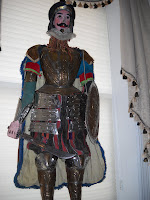
One of the life sized marionettes on display at the Westchester Italian Cultural Center Tuckahoe, NY.

In the 1800’s the Manteo’s, a Sicilian family, put its mark on this tradition by establishing the Papa Manteo Sicilian Marionette Theater in Catania. This theater became a vital part of daily lives of everyday people. In 1918, after emigrating first to Argentina and then to America, they opened a theater in Manhattan's Little Italy and entertained generations of Italians through superb storytelling.

Producer, writer, director and historian Tony De Nonno became so intrigued that he immersed himself in the lives of the Manteo family and their mission to continue the Sicilian marionette tradition. In 1982, De Nonno created the film, It's One Family -Knock On Wood, which chronicles the creativity, burdens and joys of several generations of Manteos in their fierce dedication to their craft. According to De Nonno, “The self image of many Sicilian males were shaped by these stories.”


De Nonno screened his film along with an informative presentation of the Sicilian marionette tradition on September 18, 2010 at the Westchester Italian Cultural Center in Tuckahoe, New York. He entertained the children and adults in the audience with his knowledge and manipulation of a medium sized marionette of Roland. He recounted many of the stories he learned from the Manteo’s, including how important these tales became to some audience members. One night in Little Italy, when a certain episode finished with Roland bound in a dungeon, the Manteo’s were awakened in the middle of the night by frantic knocking on their front door. A woman had become so engrossed in the story she was unable to sleep; she tossed and turned at the thought of Roland tied up in the dungeon. She begged the Manteo’s to untie Roland so that she could get some rest. They thoughtfully obliged.

Another story involved a marionette who so convincingly portrayed a cruel Saracen that a man entered the theater and shot it in the chest. The Manteo’s decided to keep the bullet hole as a memory and rather than close it, covered it with a shield. The marionette continued to perform.

On display at the Westchester Italian Cultural Center in Tuckahoe.

The Manteo’s dedication to their craft ran deep in their blood. The talent, skills and versatility necessary to sustain the Theater was passed from generation to generation. Every performance required dexterity, acting, singing, piano playing and the art of improvisation. Behind every performance were countless hours of hand crafting each marionette in the wood shop, designing and painting the faces and body, designing and hand making each costume. But that's not all; the sets were individually designed and constructed down to the curtains and pulleys. And after each performance repairs were usually required. One of the Manteo sons remarks in De Nonno’s film that they presented the Marionette Theater every night for 12 years. No nights off. Ever. The son reflected, “It's a sacrifice that you make for your family.” It makes me think that the Manteo’s were just as heroic and dignified as the stories they told.

In the 1990’s, the Manteo’s stopped presenting their tales. However, in 2010, twenty-five of their marionettes, including some created 150 years ago in Catania, were acquired by the Italian American Museum on Grand and Mulberry Streets in New York City. This is especially meaningful as this display is close to the site of the original Manteo Marionette Theater.

And what of this rich tradition today? Sicily, as well as other parts of Europe, is turning its attention to preserving this legacy. UNESCO designated the Sicilian Marionette Theater as part of humanity's “oral and intangible heritage”. The organization created a grant to build puppet theaters and puppetry schools in Catania and Palermo.

After DeNonno's presentation, we were invited downstairs to view several life-sized marionettes from the Manteo collection currently on display at the Westchester Cultural Center. This presentation was part of an ongoing celebration of all things Sicilian at the Center. Events include a photographic exhibit, food and wine specialties and the music of the region. To learn more about how you can enjoy these events, visit wiccny.org. To learn more about Tony De Nonno, visit denonnoproductions.com.

Thursday, July 29, 2010

Ghiott – An Enduring Tuscan Tradition


Today’s tale from NYC’s Summer Fancy Food Show brings us to the Ghiott Company. Florentine confectioners with a rich history, their creations still accompany coffee, vin santo and conversation throughout Italy and beyond. You can find them in the evocative Chianti region of Tuscany, very near the famous Passignano Abbey. Located on a branch of the road known locally as the Strada Senese del Sambuco, it was the Florentines’ preferred way to Siena until at least 1200, after which better routes were found.


In 1953 in Florence, Italy, Enzo Salaorni was continuing the proud tradition of his ancestors – Tuscan confectioners. This gave him access to recipes dating back to the Renaissance. Salaorni took one of the cantuccini recipes, changed it a bit, and created Ghiottini. (Cantuccini are what we think of as biscotti, but in Italy, all cookies are biscotti. Cantuccini are the oblong, twice baked creations that are perfect for dunking). This almond-based delicacy became so popular that today it is the Company’s most famous product.

Ghiottini are BVQI certified, which is an international standard ensuring both the quantity and quality of ingredients that are both traceable and typical of the region without artificial coloring or preservatives. In this case, it means whole, skinned, Mediterranean almonds, ‘A’ class egg yokes and Millefiori honey.

Ghiott’s other beloved products include Brutti e Buoni (the ultimate Tuscan cookie, crunchy with a soft, sweet center), Amaretti (soft cookies made with stone- ground rice flour, sweet and bitter almonds, sugar and whipped egg whites), Panforte Morbido (soft, round cake filled with candied fruit and almonds) and Ricciarelli (soft, oval pastry with almond paste that are considered good luck. They also make a chocolate version).


Although the Company has modernized its production technology to keep up with international demand, the Salaorni family retains its focus on manual processing methods and simple, high quality ingredients.

To learn more, visit Ghiott.com.

Caterina Ogar Dance Company – New Italians in America Interpret Life Into Movement


Movement enters sound on a dimly lit stage and comes out again on the other side. Waves of bodies and fabric turn and tell stories; kink, twist and unravel. Ancient voices, modern dilemmas and timeless themes run through the choreography of the Caterina Ogar Dance Company. To watch it is to be transported. Caterina Rago, along with fellow Artistic Director Antonio Fini, debuted the Dance Company at the Manhattan Movement and Art Center on July 11&12, 2010.


Bright movement on a darkened stage characterizes When the Sun Rises, choreographed by Rago. Lights glowed through parasols of colored paper as we voyeuristically watched 5 priestesses dance sacred morning rituals to their Goddesses. The dance was at once sacred, playful and acrobatic. The Far Eastern influences of the piece intensified the feeling of peeking into a dark temple at sunrise.


Eternal Return, also a Rago piece, was a strong statement of deeply held beliefs interwoven with her very personal life experience. A long strip of fabric metaphorically became an umbilical cord, time itself or a path enabling the fantasy of walking through the clouds. The three dancers, Antonio Pio Fini, Kerville Cosmos Jack and Ashley Rose Harvey took the journey from womb to death to rebirth, and we took it with them. The opening and closing sequences were without music, causing every squeak and slide of skin on the floor or fabric to intensify. Not a sound came from the sold-out audience as we listened to the dancers breathe as one person. When the music arose, it allowed a bit of relief from the tension that had been building. At the very end of the dance, the silence returned, and the cycle was complete.


“The Earth is like a beautiful woman changing her dress; the change is not always smooth while what is old is washed away." This statement by Fini inspired Rago to create the piece Red Earth encompassing mermaids, fish and human beings interacting with the Earth. A frozen moment in the choreography revealed a perfectly balanced Balinese altar; a sacred sculpture of dancers and red fabric that seemed to lift out of itself and become, just for a defining moment, something otherworldly and transcendent.

Violinist Susan Aquila joined the dancers in this piece, adding depth of movement and sound. At one point, Fini lifted her by her legs, turned her upside down and spun in a circle, as she continued to play the violin. Amazingly, her bow never left the strings as her body spun and moved up and down in waves.

Many of the show’s pieces were set to the music of Italian composer and musician Roberto Cacciapaglia. While living in Italy, Rago contacted him when she first heard his haunting melodies. Her dream is to take her dance company to Italy and collaborate with Cacciapaglia.

Members of the company come from all over the world: Australia, Israel, France, St. Vincent and Grenadines, New York, Pennsylvania as well as Italy. The artistic force of the company, however, remains an Italian, if not Calabrian, vision. “We can determine something from the way every person moves" said Rago, "even a simple gesture. Sometimes during rehearsals someone will tell me ‘this gesture is very Italian!’ I’ve always been told that my way of dancing and communicating is very passionate and I think this comes from the fact that I’m Mediterranean, from Calabria. During rehearsals I often say to the dancers ‘Try to be italian!’ In those moments I’m looking for something proud and majestic or at other times more passionate or effortless. I can proudly say being Italian influences my dancing and the way I think and behave.”

Just 25 years old and in New York City by way of San Lucido, Calabria and Rome, Rago is a member of the Martha Graham Dance Company. It was there that she met 27 year old Fini, also from Calabria, and their collaboration on and off the stage further fueled her choreography and desire to create a dance company. The name Ogar is Rago spelled backwards, a suggestion her father made to her when she was a child. “He always believed in me and told me I should use Caterina Ogar as my artistic name. The more I thought about it, the more I liked it, so I always knew I would use this name.” She began choreographing for the stage when she was 15 and trained at the prestigious Accademia Nazionale di Danza in Rome.

“I’m a visual person and I try to give those images life,” says Rago. “As a dancer I need to dance because it’s my life, it’s everything for me. To choreograph means to give life to my imagination. As I love to dance, I must choreograph; I need to. There is nothing that I can do about it.” Although the art of choreography requires being a skilled dancer and teacher, it also demands more. Rago explains that “something extra” this way, “First, you need a crazy mind! Then, motivation and determination.”